

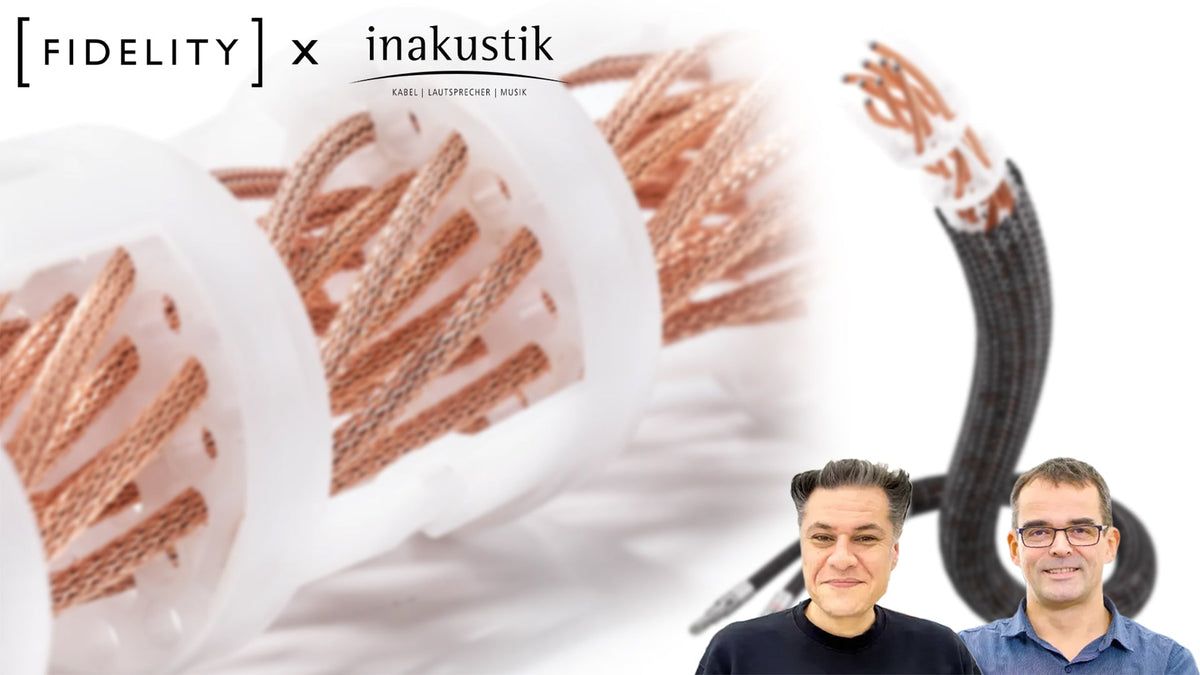
On October 7, 2026, things got a little more technical here in Rellingen: Together with Kambiz Hashemi from in-akustik, we held two workshops on the topic of Hi-Fi cables.
In a deliberately small group, the focus was not only on products, but above all on the questions behind them: How does in-akustik develop its cables? What is important in construction and insulation? And how should cables be compared effectively?
For the technical part, Holger Wachsmann, cable developer at in-akustik, was also connected live via video call and was able to answer many questions directly from a developer's perspective.
An introduction to the world of in-akustik
Kambiz Hashemi opened the two workshops with an insight into the history and philosophy of in-akustik.
This also involved how the company fundamentally approaches the topic of cables and what role comprehensible technical relationships play in development.
One point became particularly clear: in-akustik deliberately does not want to engage in "voodoo". According to their own statement, only constructive measures are used whose effect is technically comprehensible or measurable – and which, ideally, can also be reflected in an listening comparison.
How to compare cables effectively?
A central topic for Kambiz was the question of how cables should be compared effectively at all.
Instead of constantly switching back and forth between two cables and looking for differences in short A/B comparisons, in-akustik recommends a much more relaxed approach.
The new cable should first remain permanently in your own system for about one week. During this time, you listen to music normally – at different times of the day, in different moods, and with completely different music material.
The idea behind this: You first get used to the new setup and get a feel for how your own system behaves with it over a longer period of time.
Only after this phase do you switch back to the previous cable. Then, from in-akustik's point of view, it is easier to judge whether any difference is perceived at all – and above all, which variant you personally like better.
A look at development
For the technical part of the workshops, we had Holger Wachsmann join us live via video call.
He gave insights into the development of in-akustik cables and also showed various cable cross-sections and construction details that you normally do not see in the finished product.
One focus was on the AIR series by in-akustik and the question of why air is used so consistently as an insulation medium there.
Why air as insulation?
With the AIR series, in-akustik aims to surround the conductor with as few solid insulation materials as possible.
Instead, the conductors are constructed in such a way that they are largely surrounded by air. The background is the approach of keeping unwanted electrical influences of the insulation on the signal as low as possible.
Holger explained in the video call how these constructions are created, what considerations play a role in development, and why the geometry of the cable is just as important as the materials used.
Measure, develop, and then listen
The basic development approach of in-akustik was also exciting.
New ideas are not implemented based on listening impression alone. The decisive factor is first that a technical effect can be comprehended and measured.
Only then is it checked whether this change is also noticeable when listening to music. Exactly this combination of technical development, measurement, and practical listening comparison forms the basis for the company's own cable concepts, according to in-akustik.
Why cables should be broken in
The topic of breaking in cables of course could not be missing.
in-akustik recommends giving new cables a certain operating time first before making a final comparison.
That is also why this approach fits the previously described listening test: The new cable remains in the system for several days first before switching back to the previous connection.
In the workshop, it was explained what experiences in-akustik has gathered in development and practice in this regard and why the company takes this period into account when testing.
Questions directly to the developer
Especially due to the small number of participants, there was plenty of time for personal questions in both sessions.
While Kambiz Hashemi contextualized the topics on site and established the practical connection, Holger Wachsmann was able to answer technical questions directly from a developer's perspective.
This created an open exchange about cable construction, insulation, development, measurements, and of course the question of how to best judge differences in your own system yourself.
Thank you very much for two exciting workshops
Thank you very much to everyone who participated in our two sessions and brought their questions.
A special thank you goes to Kambiz Hashemi for accompanying the workshops on site, as well as to Holger Wachsmann for the technical insights directly from development.
For us, it was an exciting afternoon where it was less about simply presenting cables, but much more about understanding how in-akustik develops, how they compare, and what technical considerations are behind the products.
We are already looking forward to the next workshop at Fidelity.
Share: