

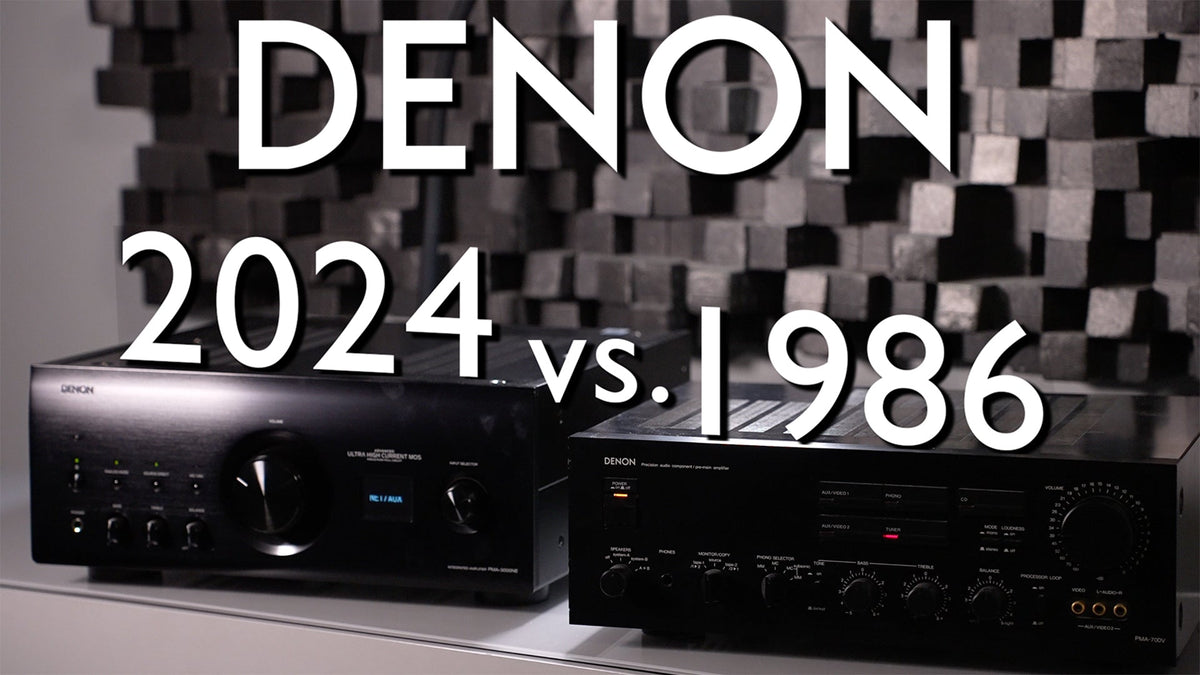
Old versus new – this format has a long tradition at Fidelity Hamburg. Years ago, we compared Bowers & Wilkins speakers across generations, followed by Canton, T&A and Technics. This time it was about amplifiers – and a particularly personal duel at that. For the test, we didn't simply pull some random vintage device out of storage: Frank brought a Denon PMA-700V from 1986 down from his own attic. Facing it is the current Denon PMA-3000NE, the flagship of the high-end class with everything modern amplifier technology has to offer today. Almost 40 years separate the two devices – and that is exactly what makes the question so exciting: How much progress is really packed into four decades of amplifier development, and is an upgrade for your own system actually worth it? To find out, we didn't just compare them once, but twice – once with current speakers and once with equally historic speakers. This shows whether the amplifier really is the deciding factor, or whether in the end the speakers have the last word.

In short:
Denon PMA-3000NE: For anyone who wants the best possible sound – with noticeably more resolution, emotion and soundstage, plus modern connections. It shows its full potential above all with current speakers.
Denon PMA-700V: For vintage fans and collectors with a matching vintage system – it still impresses today with its warm, harmonious sound, but falls behind sonically with modern speakers.
Table of Contents
- The candidates at a glance
- Music recommendation
- The test chain
- Listening comparison by criteria
- Build quality & appearance
- Technical specifications compared
- Conclusion / What is for whom
- Video of the test
- FAQ
- Listen to a sample now
The candidates at a glance
Denon PMA-3000NE – the current flagship
The Denon PMA-3000NE is one of the brand's current top amplifiers and its technical specifications live up to this claim. The two-channel integrated amplifier with an integrated MM/MC phono stage delivers 80 watts per channel into 8 ohms or 160 watts into 4 ohms and is manufactured entirely at Denon's factory in Shirakawa, Japan. Inside, four ESS ES9018K2M converters work together with Denon's Ultra AL32 Processing – a combination responsible for the fine, detailed reproduction that distinguishes this amplifier. In addition, it features optical, coaxial and USB digital inputs, as well as a dedicated analog mode that bypasses the entire tone control and enables the most direct signal path. Weighing 24.6 kg, it is a real heavyweight and costs €3,700.

Denon PMA-700V – the amplifier with history
The Denon PMA-700V has a history that goes beyond pure technology. In the mid-1980s, it was Frank's first really good amplifier – painstakingly saved for as a student, costing around 1,000 DM at the time, a real statement piece, financed with every available penny and the sale of one or two devices from his circle of friends. He still remembers the moment he unpacked it: a device that looked incredibly impressive and was built to a high standard. Out of pure curiosity – do you really remember it correctly, or does nostalgia romanticize it? – Frank bought the device again years later on Kleinanzeigen, even though he had long since no longer owned it. Since then, it had been sitting in the attic, waiting for exactly this kind of test. Technically, the PMA-700V is a pure analog device without a remote control, manufactured in Japan in 1986 and costing a recommended retail price of 998 DM at the time. With eleven inputs – from phono MM/MC to tuner, two Aux and two tape connections, as well as two video inputs – it was lavishly equipped for its time. The continuous power output is 2 x 100 watts RMS into 8 ohms, with a total harmonic distortion of less than 0.02%. Weighing 10.5 kg, it is significantly lighter than its modern successor.

Music recommendation
Before getting to the system, there were, as always, first music tips from the editorial team – and this time they fit the old versus new theme of the test perfectly. We recommended, among others, "Baker Street" by Gerry Rafferty from 1978 – and the covered version from 2015, sung by Shawn Colvin. Two versions of the same song, almost 40 years apart – it couldn't be more fitting for this test. Added to that was a real insider tip from the printed Fidelity magazine: "Jessica" by the Allman Brothers Band, a live recording from 1991 – groovy, played fast and packed with details.
The test chain
A Denon network streamer from the 2000 series (Denon DNP-2000NE, please check the spelling) served as the playback device, feeding both amplifiers digitally. For a fair comparison, the most direct signal path was deliberately chosen for both amplifiers. The PMA-3000NE ran in analog mode with the tone control completely deactivated, while the PMA-700V used the corresponding tone defeat circuit, which also bypasses all tone controls. We first listened through the current T&A Pulsar S130, then through a pair of T&A speakers from the Kriterion series (model T130E) as a sonic counterpoint – not to compare the speakers against each other, but to check whether the difference between the amplifiers is just as pronounced with older speakers.
Listening comparison by criteria
Bass & dynamics
With the current T&A Pulsar S130, the PMA-3000NE showed more control and punch in the bass from the very first second – the low notes sounded more defined, and the amplifier seemed to have a more confident grip on the speakers. The PMA-700V, by contrast, played more reservedly, almost cautiously. With the old T&A speakers, the picture interestingly shifted slightly: here, the vintage amplifier brought noticeably more punch in the fundamental range, but sounded less controlled and tended to be somewhat exaggerated – a rumble that the new amplifier consistently avoided. Overall, the PMA-3000NE remained punchier and livelier, but the gap to the old device narrowed significantly with the historic speakers.
Vocals & midrange
Both amplifiers placed vocals cleanly in the foreground, right in front of the piano. The decisive difference lay in the details: with the PMA-3000NE, the decay of vocals sounded astonishingly accentuated – the finest ambient noises when lips open and the last note fades away were clearly audible. With the PMA-700V, these very subtleties became noticeably blurred. The leap in resolution was also evident with the piano: through the new amplifier, you could unmistakably hear a real acoustic grand piano, while with the old amplifier it remained unclear whether a real piano or a digital piano was playing – a difference that immediately catches the ear of anyone who plays the piano themselves.
Soundstage & spaciousness
With the new T&A speakers, the PMA-3000NE opened up a soundstage that truly stood three-dimensionally in front of the listener – vocals and instruments literally detached themselves from the speaker. This exact spatial magic was completely missing from the PMA-700V in this combination; it remained flatter and less room-filling. With the old T&A speakers, the soundstage felt narrower and more focused on the center with both amplifiers overall – almost as if an invisible center speaker were playing along. For music, we found this somewhat cramped; this showed that it was the speaker rather than the amplifier that set the limit.
Resolution & detail
With the current speakers, the PMA-3000NE's resolution advantage was unmistakable: more brilliance, more fine details, noticeably fewer ambient noises. This advantage remained with the old speakers – for example, the PMA-700V lacked audible overtones during drum breaks, and the sound overall seemed duller –, but it was significantly smaller than before. The T&A T130E simply could not fully convey the higher resolution of the new amplifier and noticeably limited the difference. This was exactly the central finding of this pass: the speaker became the bottleneck of the entire chain.
Want to know how your own system performs in a direct comparison? Feel free to bring your components to our studio – we will set up the comparison for you.
Build quality & appearance
Denon PMA-3000NE
The PMA-3000NE brings a noticeable weight of 24.6 kg to the scales – a device that impresses with its solidity right from the moment you unpack it. The brushed front, the volume control that clicks firmly into place, and the informative, albeit sonically irrelevant display underline the typical Denon high-end character. A detachable power cable, which is a given today, was still unthinkable with the predecessor from the 80s. The amplifier is available in black and silver – both versions look equally high-quality:


The rear also shows how much four decades of amplifier construction differ: massive, gold-plated speaker terminals for two pairs, and next to them the complete digital section with three optical, one coaxial and one USB-DAC input.

Denon PMA-700V
The PMA-700V was manufactured in Japan in 1986 and was available in champagne or black. At 10.5 kg, it is significantly lighter than its modern successor – yet even after four decades, it still looks astonishingly high-quality, with solid switches and a chassis that does its price class and era proud. The fact that it is still fully functional, although it has never been serviced, speaks for its build quality – although the aging of the components is certainly noticeable in the soundstage over the decades. Next to the 24.6 kg PMA-3000NE, however, the former wow effect is somewhat relativized: What was considered an impressive heavyweight in 1986 is a relatively slim device today.
Listened to with:
- With the T&A Pulsar S130: a track with gentle vocals and piano accompaniment | Summer Haize - Easy
- With the T&A T130E: Jimit - Changes
Technical specifications compared
| Criterion | Denon PMA-3000NE | Denon PMA-700V |
|---|---|---|
| Power per channel | 80 W (8 Ω) / 160 W (4 Ω) | 100 W RMS (8 Ω) / 120 W (4 Ω) |
| Supported formats/resolutions | PCM up to 384 kHz/32-bit, DSD up to 11.2 MHz (USB), digital inputs up to 192 kHz/24-bit | pure analog, no digital inputs |
| Streaming services/protocols | no integrated streaming (no WLAN, no HEOS) | not available |
| Inputs/outputs | 4 analog inputs (incl. phono) + 1 REC Out, 3x optical, 1x coaxial, 1x USB-B, headphone output | 11 inputs (phono MM/MC, CD, tuner, 2x Aux, 2x tape, Processor In, 2x video), 2 pairs of speakers, Tape 1/2, Processor Loop Out, Video Monitor Out |
| DAC | 4x ESS ES9018K2M, Ultra AL32 Processing | no DAC (pure analog device) |
| Display | N/A | N/A |
| App | not available (no network connection) | not available |
| Dimensions (W x H x D) | 434 x 182 x 443 mm | 434 x 157 x 397 mm |
| Weight | 24.6 kg | 10.5 kg |
| Colors | Black, silver | Champagne, black |
| Price | €3,700 | 998 DM recommended retail price (1986), no current market price available |
Conclusion / What is for whom
Four decades of amplifier development sound astonishingly clear on the right speakers. With the current T&A Pulsar S130, the difference between the two Denon amplifiers was almost striking: more soundstage, more emotion, more resolution – the PMA-3000NE turned the same recording into a different listening experience. But it only became really exciting with the old T&A speakers, where both amplifiers came closer together sonically. That is the real finding of this test: A new amplifier almost always brings a noticeable added value – control, resolution, emotion. But its full potential can only be realized if the speaker also plays along. Anyone thinking about a system upgrade should therefore never look at the amplifier in isolation, but always keep the entire chain in view – it is only as good as its weakest link. And for all collectors and nostalgics: The PMA-700V has lost none of its charm after almost 40 years. In combination with an equally historic speaker, it plays with a harmonious, warm sound and a musicality that shows why some devices are still worth keeping in the attic today.
We also shot a video about this
If you prefer to see the topic rather than read about it: We also had the two Denon amplifiers compete against each other in front of the camera – once with the current T&A Pulsar S130, once with the old T&A from the Kriterion series. Feel free to check it out, there you can hear the differences for yourself in peace.
FAQ
Is a new integrated amplifier worth it if I keep my old speakers?
Yes, a noticeable sound improvement remains in any case – more control, resolution and dynamics are also noticeable with older speakers. But the full potential of a modern amplifier only unfolds with an equally modern speaker.
What is the biggest sonic difference between the PMA-700V and the PMA-3000NE?
Above all resolution and spaciousness: The PMA-3000NE places instruments and vocals significantly more three-dimensionally and with more detail, while the PMA-700V sounds warmer overall, but less differentiated.
Can the Denon PMA-3000NE also play streaming services?
No, the PMA-3000NE is a pure integrated amplifier without its own streaming module – no WLAN, no HEOS on board. For network streaming, an external playback device is needed, as we also used in the test.
How much does the Denon PMA-3000NE cost?
The Denon PMA-3000NE costs €3,700.
Can I test my own system against a new amplifier at Fidelity?
Yes, gladly. Simply bring your components to the studio, or we will set up the comparison for you – so you can hear for yourself whether an upgrade is worth it for you.
Listen Now
Want to hear for yourself what a modern amplifier can bring out of your system? Schedule a consultation in our studio – we’ll listen together with your own speakers and tracks, at your leisure.
Fidelity
Share: