

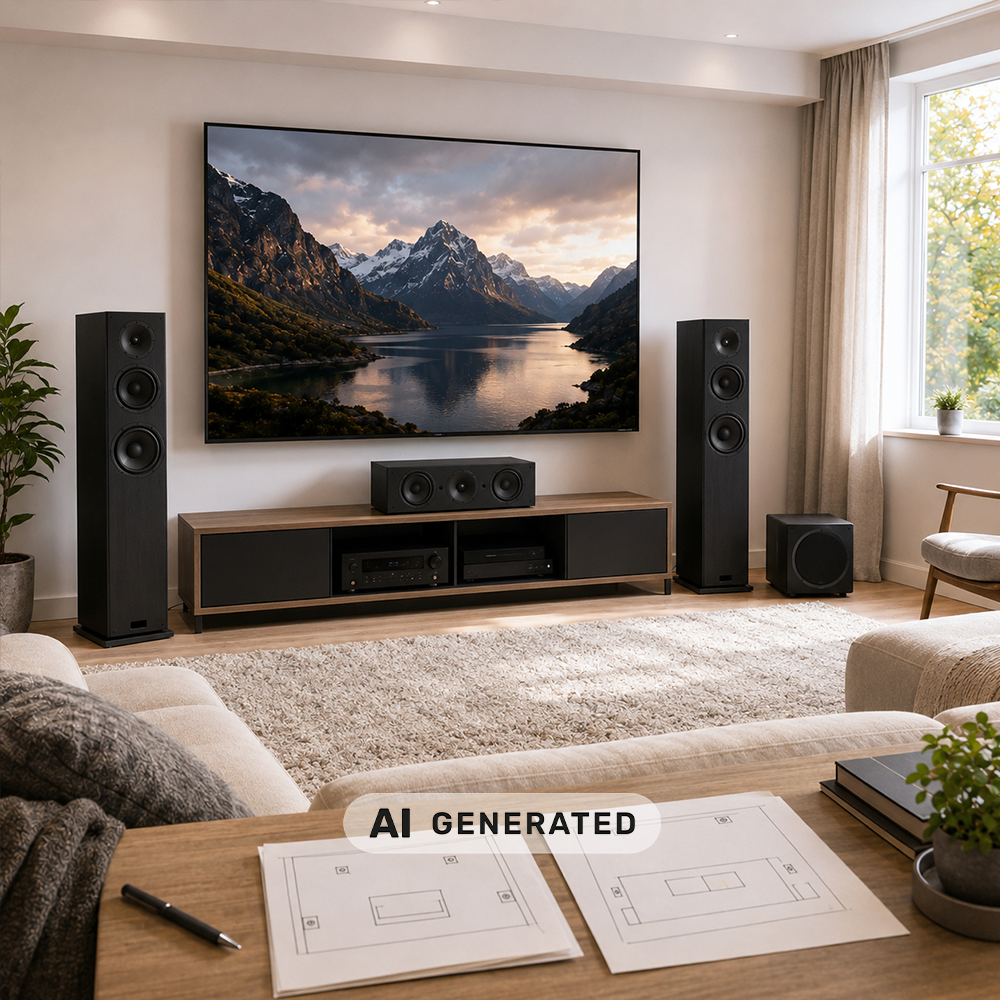
Planning a home cinema can initially feel like an overwhelming mountain of questions: 5.1 or 7.1? Is a soundbar sufficient? TV or projector? And what on earth does 7.2.4 mean?
This guide will sort it out. It shows you which expansion stages exist and what each one truly offers, which room concepts are suitable – from the living room to invisibly installed speakers and a dedicated cinema room – why your room determines the sound more than the price of the speakers, and in which order you should most sensibly allocate your budget. By the end, you'll know which setup suits your situation, which mistakes you can avoid, and roughly what a home cinema costs.
Take twenty minutes. They'll be well spent – you don't buy a home cinema every year.
Table of Contents
- The two questions that determine everything else
- Expansion stages: from soundbar to height layer
- Room concepts: living room, invisible, dedicated room
- The display: TV, short-throw, or projector?
- Why the room determines more than the price
- Where your money should go first
- What does a home cinema really cost?
- Home cinema in a rented apartment
- Typical mistakes and bad purchases
- How far we go with you
- Conclusion: Which setup for whom?
- FAQ
1. The two questions that determine everything else
Before you start thinking about individual devices, answer two questions. Everything else will almost follow from that.
Question 1: How serious are you?
Do you simply want clearer voices and a bit more impact during a series night? Or do you really want to forget you're sitting on your sofa during a film? This isn't a question of right or wrong – but it determines the expansion stage.
Question 2: Where will it be located?
In the living room, which is also used for living, eating, and listening to music? Or in a room you can dedicate to this one purpose?
Important: These two axes are independent of each other. There are full-fledged 7.2.4 setups in perfectly normal living rooms, and there are dedicated cinema rooms with a neatly arranged 5.1 and a simple roll-down screen that work wonderfully. So you don't have to choose a package; instead, you combine the level you want with the concept that fits your living situation.
However, there is an asymmetry: a dedicated room can do everything a living room can – the reverse is not true. More on that below.
2. Expansion stages: from soundbar to height layer
Soundbar: when it's the right answer
A soundbar isn't a "bad home cinema," but rather a distinct solution with a clear profile. It's right for you if there's no space for multiple speakers in the living room, you can't or don't want to lay cables, the whole setup should remain visually unobtrusive – and your main goal is better speech intelligibility and more fullness than your TV sound, not maximum immersion.
What a soundbar fundamentally cannot achieve: true localization of sound sources around you. Effects that truly come from diagonally left behind need a speaker there. Virtual methods can suggest this but cannot replace it.
For the rest of this post, we'll focus on true multi-channel setups. If you find that a soundbar is the more suitable path for you: our Soundbar Buyer's Guide covers the topic in depth. To the product range, go here: Soundbars
5.1: the foundation
Five speakers plus subwoofer: front left and right, center, two surrounds at the back or sides, plus the subwoofer for the foundation.
This is the stage from which one can speak of a true home cinema – and for most living rooms, it's also the most sensible. The leap from TV sound or a soundbar to a properly set up 5.1 is the biggest you'll experience in this entire topic. Everything after that is refinement.
The center speaker is the most important, even if it's rarely treated as such. Virtually all speech runs through it. A good center speaker determines whether you reach for the remote during quiet dialogues or simply listen.
7.1: more enveloping sound to the rear
Two additional speakers, but not simply "more of the same": The existing surrounds move to the side of your listening position, while the new surround-back speakers cover the rear area. The result is a more uniform sound field instead of a gap between the sides and the back.
7.1 is worthwhile if you actually have space behind the couch. If the sofa is against the back wall, the benefit is minimal to counterproductive – the rear speakers will then be practically at your ear.
And a rule we take very seriously: Prefer two perfectly placed surrounds over four mediocre ones. If you can't accommodate four symmetrically and with reasonable spacing, invest the money in two better speakers at the right positions. The result will be audibly superior.
The height layer: Dolby Atmos, DTS:X and Co.
Only here does a flat sound field become a true space. The third digit in designations like 5.1.2 or 7.2.4 refers to the height speakers – rain, helicopters, reverberation in a cathedral.
There are two ways to achieve this: add-on speakers placed on your existing speakers, which reflect sound off the ceiling – without a single drill. Or true in-ceiling speakers, which are installed according to specifications and provide significantly more precise localization, but require structural modifications.
Important: The height layer is the icing on the cake, not the foundation. If the lower layer is not properly set up, it brings little – but with a proper lower layer, it brings a lot.
We cover in detail how these formats work, which angles apply, and which setups are sensible in a dedicated post. And for height speakers directly: Dolby Atmos Speakers
Multiple subwoofers: the underestimated expansion stage
The second digit (the ".2" in 7.2.4) stands for subwoofers. Two subwoofers are not twice as loud – they make the bass more evenly distributed across the seating positions. In a room, standing waves form: at one spot, it rumbles, a meter away, the same tone is almost entirely missing. A second sub in the right position significantly smooths this out.
Those who regularly watch movies with multiple people often get more out of a second subwoofer than from two additional surround speakers.
To the product range: Home Cinema Speaker Sets · Subwoofers · Center Speakers · Surround Speakers

3. Room concepts: living room, invisible, dedicated room
Before we go through the three concepts individually: We once covered all the options you have at home in a video – from the living room to a dedicated room.
Concept 1: The Living Room Cinema
The classic approach and the right one for most people. Speakers are visible, the room remains a living space, and the system has to fulfill two jobs: movies in the evening, music during the day.
That's precisely why the stereo quality of the front speakers is particularly important here. A setup optimized only for movie sound will bring little joy when listening to music. Conversely, good stereo speakers function excellently as the front of a home cinema system.
The big advantage: You see your speakers, you can choose them by sound and appearance, and you can rearrange, supplement, and optimize at any time.
The limitations: Furniture gets in the way, window fronts reflect, the couch is meant to be where it is – and room acoustics can only be influenced to a limited extent without making it look like a recording studio. Here, one works with compromises. Good compromises, but compromises nonetheless.
Floorstanding Speakers · Bookshelf Speakers · Speaker Stands
Concept 2: Invisible – In-wall and in-ceiling speakers
For anyone who doesn't want visible technology in the room. There are two variants: in-wall speakers or in-ceiling speakers, where a grille is still visible. And invisible speakers, which disappear under plaster, are painted over, and then are simply no longer visible.
The appeal is obvious: a completely clean room, no black hole on the wall when a motorized screen or picture hangs in front of it, and all electronics disappear into a cabinet.
The catch: This needs to be planned early. It makes sense for new construction, a core renovation, or if a ceiling is being suspended anyway. Retrofitting it into an occupied apartment is complex to impossible. Anyone considering it should therefore speak with us very early – not just when the plaster is already on the wall.
Custom Installation · On-Wall Speakers
Concept 3: The dedicated cinema room
A dedicated room that doesn't have to be anything else. This happens more often than one might think – often when children have moved out and a room becomes free.
Here, every compromise is eliminated. You can choose dark wall colors and completely eliminate stray light, which benefits a projector's image more than any equipment upgrade. You can use an acoustically transparent screen and hide front speakers plus subwoofer behind it – sound then comes precisely from the image. You can determine the seating position based on acoustic criteria instead of furniture arrangement. And you can implement true room acoustics: absorbers, diffusers, bass traps.
You can see what something like this looks like in the end at our place: We built our own cinema room from scratch and fully exploited these possibilities.
A realistic approach, often chosen by our customers: a solid, cozy setup in the living room for everyday use – and a dedicated room for those evenings when it truly needs to be a cinema experience.
4. The display: TV, short-throw, or projector?
A home cinema is not just about sound. Three paths lead to the big picture – here's the short version, detailed in Projector, Laser TV, or Television?
Television. Highest brightness, best contrast, works in a brightly lit room without any preparation, very low latency for gamers. Disadvantage: Size has practical limits – not only in price but also in transport into the apartment. And there's a permanent black rectangle hanging on your wall.
Short-throw projector (Laser TV). Sits on a piece of furniture close to the wall and still produces a very large image. Significantly brighter than a classic projector, suitable for daylight – but absolutely requires a special high-contrast screen whose structure rejects light coming in from the side and above. Without this screen, you're missing out on the main advantage. A second point many overlook: the projector sits where the center speaker should be. This needs to be thought through beforehand.
Classic projector. The largest screen diagonal, the softest, most cinematic image, and it disappears into the ceiling. The price for this: It needs a darkened room. In daylight, black turns to gray, and even the best screen only partially remedies this. Anyone who can darken the room will get the most impressive picture here.
Regarding the screen in brief: Roll-up screens disappear when not in use but can become slightly wavy over the years – tension variants stretch the fabric sideways and prevent this. Fixed-frame screens are always flat but always visible. And if the center speaker is to go behind the picture, you need an acoustically transparent (micro-perforated) screen.
Projectors · Televisions · Mounts & Stands
5. Why the room determines more than the price
This is the section that surprises most people in the store: a carefully set up mid-range system outperforms an expensive system that's incorrectly placed in the room. Every time.
Seating position is the most important lever. Two things matter: distance to the back wall and position in the room. A sofa directly against the back wall is the most common cause of disappointing surround sound – the rear speakers are then practically at your ear, and instead of a sound field, you hear individual speakers. Approximately one meter distance is the target. And: try not to place the couch in the middle of the room. Reflections overlap particularly unfavorably there; the back third is usually the much better choice.
Speakers need space. Squeezed directly into a corner or against a wall, the bass bloats and overpowers the lower mids – the result sounds muddy rather than precise. 30 cm distance from boundary surfaces is a start, 50 cm is noticeably better.
The surface matters. On carpet, speakers are coupled to the floor with spikes; on hard floors, they are decoupled with dampers. In both cases, the bass becomes more precise and speech intelligibility increases.
The center speaker needs to be unobstructed. It should not be pushed into the rack or far back onto the sideboard, where it radiates against furniture surfaces. Place it at the front edge, if necessary slightly overhanging – and if it's too low, angle it towards the listening position with feet.
All of this costs almost nothing and delivers more than the next higher price range. How to optimally position each individual speaker is covered in detail in Setting up speakers correctly. Suitable accessories: Dampers / Decouplers · Wall Mounts
6. Where your money should go first
If your budget is limited – and it usually is – then in this order:
1. Room and setup. Costs nothing and yet is most frequently skipped. See the section above. Start here before you spend a single dollar.
2. Front left/right plus center – from the same series. These three carry the film. The center handles voices, the fronts provide the foundation and stereo enjoyment. Quality here pays off the most. And definitely from the same series: identical tweeters, identical sound signature. Otherwise, you'll hear the character change with every pan across the front.
3. The subwoofer. The step that transforms "sound" into "cinema" – and simultaneously relieves your front speakers and AV receiver from energy-intensive low frequencies. However, it also requires the most attention in terms of placement and adjustment. A model with integrated calibration will save you a lot of work and is generally worth the extra cost. Subwoofers
4. The AV receiver. It doesn't have to be the most expensive, but it must have the features you actually need – otherwise, you'll be buying new in two years. Specifically: enough power amplifiers for the channels you plan (if you want Atmos later, you need the channels now), the audio formats you want to use, sufficient and current HDMI ports for your sources – and a powerful calibration system if your room is acoustically challenging. In critical rooms, this is precisely where an upgrade is most worthwhile. Details in AV Receiver Buying Guide · AV Amplifiers
5. The display. A special rule applies here: If you already have a decent television, invest in sound first – the jump is bigger. If you're starting completely from scratch, the display naturally belongs in the budget from the beginning and is planned in parallel, because the display and speaker placement depend on each other (keyword: where to put the center?).
6. Surround speakers. Important for immersion, but carry less signal content than the front speakers. Better two good ones than four mediocre ones.
7. The height layer. The bonus. Without a clean lower layer, it brings little – but with a clean one, a lot.
8. Fine-tuning and accessories. Decoupling, proper speaker jumpers instead of the included flimsy ones, careful calibration. Small money, noticeable effect. Speaker Cables
And room acoustics? It's intentionally not on this list – not because it's unimportant, but because most people don't want to implement it in their living rooms. However, once you're ready to use absorbers and diffusers, acoustics belong right at the top. In a dedicated cinema room, it's one of the most crucial factors – there, it brings more than the next class of equipment.
7. How much does a home cinema really cost?
Honest answer: Blanket figures are difficult here because too many variables are at play. Nevertheless, here are a few clues so you know the magnitude you're thinking in.
The entry level starts with a satellite system – five small speakers plus a subwoofer – combined with a compact AV receiver. This is in the low four-figure range and already delivers true multi-channel sound.
The next level is four full-fledged compact speakers, a subwoofer, and an AV receiver. That puts you at a good 3,000 Euros and gives you a 5.1 that can be taken seriously.
A really good living room 5.1 is more like 7,000 Euros. The sky's the limit – 15,000 or 20,000 Euros are not uncommon for a 5.1 with high-quality floor-standing speakers and a corresponding receiver.
All these figures apply to sound without picture. TV, projector, or short-throw projector plus screen come on top. As do any further steps: more channels, a second subwoofer, the height layer, room acoustics, cinema seats, on-site setup and calibration.
Realistically, the projects we implement range from approximately 3,000 Euros to over 200,000 Euros. This is not boasting, but the honest range – and the reason why we prefer to offer personal advice on this topic rather than handing out a price list.
The most important budget advice: Plan for the expansion stage you want in three years. An AV receiver with enough channels costs a little more today and will save you a complete new purchase later.
8. Home Cinema in a Rented Apartment
Not being allowed to drill is not an exclusion criterion – it just shifts the priorities.
What works without structural modifications: Front and center speakers are always placed on furniture or stands anyway. Surrounds can be placed on stands instead of being screwed to the wall. For the height layer, there are add-on speakers that are simply placed on top of the front speakers and reflect off the ceiling – no ceiling mounting necessary. And a projector can be placed on a shelf if ceiling mounting is out of the question.
Cable routing without chasing walls: Flat cables under carpet edges or behind skirting boards, cable ducts in wall color, or the simple option of running the cable along the baseboard. Not elegant, but invisible enough – and significantly better than doing without surround sound.
What you should realistically plan for: In multi-family homes, the subwoofer is the critical point. Low frequencies travel through walls and ceilings. Decoupling the subwoofer from the floor helps noticeably, as does a night mode on the AV receiver, which limits the dynamic range. And a second, smaller subwoofer often produces more bass at your listening position with less volume throughout the house than a single large one.
Speaker Stands · Wall Mounts · Dampers / Decouplers
9. Typical Mistakes and Bad Buys
Mixing speakers from different series. The most common and most expensive mistake. Center from one series, fronts from another, something else entirely at the back – sound comes out, but the sound signature changes with every pan. Better to go one step smaller, but from the same family.
Rather a mediocre 7.1 than a proper 5.1. Four speakers crammed somewhere at the back will sound worse than two well-placed ones. First set up 5.1 properly and save up for the expansion.
Placing the center speaker inside furniture. Happens constantly. It then fires against wood and glass, voices become muffled – and then people wonder about poor speech intelligibility. It belongs freely at the front edge.
The couch against the back wall. Visually obvious, acoustically a classic problem. If at all possible: move it away.
Leaving in the metal jumpers. Almost every speaker with bi-wiring terminals comes with simple metal jumpers. Replacing them with proper cable jumpers costs little and is audibly beneficial.
Buying a TV that's too big for the room. Not just because of price and viewing distance – a very large TV often no longer fits up the stairs or in the elevator. Measure beforehand.
Forgetting the screen with a short-throw projector. Without a suitable contrast screen, you're missing out on the decisive advantage. And the position where the projector needs to stand often conflicts with the center speaker.
Blindly relying on calibration. A calibration system corrects many things, but it cannot fix incorrect placement. And if it intervenes too strongly, it takes away the liveliness of the soundstage. First set up correctly, then calibrate.
Buying too few power amplifiers. Anyone building 5.1 today, but wanting Atmos in two years, will be annoyed by a receiver without the necessary channels.
10. How far we go
When it comes to home cinema, the range of what customers need is greater than in any other category. That's why we work on four levels – choose how much you want:
As a specialist retailer for individual components. You know what you want and need speakers, a receiver, a projector or a screen. We deliver and are available to answer any questions.
With advice and planning. We look at your room situation, plan the setup, coordinate components, and you receive a coherent overall concept instead of a collection of individual devices.
With on-site setup and calibration. We come to you, set everything up correctly, wire it, calibrate it, and optimize it by ear. Exactly the work that lies between "it works" and "it's great."
As a complete installation. Invisible in-wall speakers, a dedicated cinema room, acoustically transparent screen, room acoustics, seating, control. From the first drawing to the finished room.
You can listen to and see all three concepts live with us – living room cinema, invisibly installed room and dedicated cinema room. This replaces any description. See consultation & installation →
A note on this: We take plenty of time for a proper home cinema demonstration. Therefore, please register in advance instead of just dropping by – then we can dedicate the attention to the topic that it deserves.
11. Conclusion: Which setup for whom?
You simply want better TV sound, have little space, and don't like visible technology. → Soundbar. Honestly and straightforward: This is the right solution for you. Soundbar Buying Guide
You want a true cinema experience in a normal living room. → 5.1 with proper front speakers and a center from one series plus a subwoofer. Invest care in the setup, not in additional channels.
You have space behind the couch and want more. → 7.1, or alternatively 5.1 with a height layer via up-firing speakers. Both are useful – more envelopment at the back, more dimension above.
Your living room should remain clean, and you're renovating anyway. → In-wall or invisible speakers. But plan early, very early.
You have a room free that you can sacrifice. → Dedicated cinema room. Here you get everything out of it without compromise – and here it is also worth investing in room acoustics, which are usually out of the question in the living room.
You have a limited budget and want maximum effect. → Front and center from one series, a good subwoofer, careful setup. The rest can wait and be added later.
FAQ
Is a 5.1 system sufficient, or do I absolutely need Atmos?
5.1 is perfectly sufficient for a very good home cinema. Atmos adds an additional dimension but does not replace a solid lower layer. First build a proper 5.1, then add height later.
Do all speakers have to be from the same manufacturer?
Front, center, and surround should come from the same series – same tweeters, same sound signature. With the subwoofer, this is not critical; it operates in a frequency range where the sound signature plays hardly any role.
Can I continue to use my existing stereo pair as fronts?
As a rule, yes, and this is often a very good approach. Make sure to choose a center that matches the sound – ideally from the same series or at least from the same manufacturer.
How big can the TV for my room be?
When watching movies, the viewing distance is less restrictive than many think – modern resolutions allow for significantly closer seating than before. The more practical limits are usually wall space, price, and whether the device even fits into the apartment.
Do I absolutely need a subwoofer if I have large floor-standing speakers?
Yes, for home cinema you do. The LFE channel contains signals that even large floor-standing speakers cannot reproduce. Additionally, a subwoofer noticeably relieves your fronts and receiver.
How long does such a setup remain current?
Speakers last decades. The electronics are the part that ages faster – usually due to new connection standards and audio formats. That's why it's worth planning a little more generously for speakers than for the rest.
How to proceed
If you've read this far, you probably already have a rough idea of what direction you want to go. The next step is simple: tell us about your space. Floor plan, seating position, what you envision, what's structurally possible and what's not.
We will then plan a setup that suits you – and you can hear it from us beforehand.
See consultation & installation →
Tell us about your room →
Directly to the assortment: Home Cinema Speaker Sets · AV Receivers · Subwoofers · Projectors · Custom Installation
Author: Mark Last


Share: